Gary Dolch
Phone
512-656-5627
Email
[email protected]



Media rooms and home theaters got some healthy use this past weekend as millions of people settled in to watch this year's Super Bowl. And with the ongoing Winter Olympics in Milan, that action is set to continue, with people tuning in to watch the international competition broadcast into their homes.
But these entertainment spaces are worlds away from the stark, cave-like rooms of 20 years ago, industry professionals say. Instead, leaps in entertainment technology, paired with the asynchronous TV-watching habits enabled by streaming dominance, have nudged homeowners toward cozier, more design-forward spaces that aren’t quite so tucked away.
“I think people are breaking the rules of what a theater room is,” said Andrew Davis, the managing partner of Gramophone Design Build and partner of World Wide Stereo. “But I think that’s making it more fun for the family to utilize.”
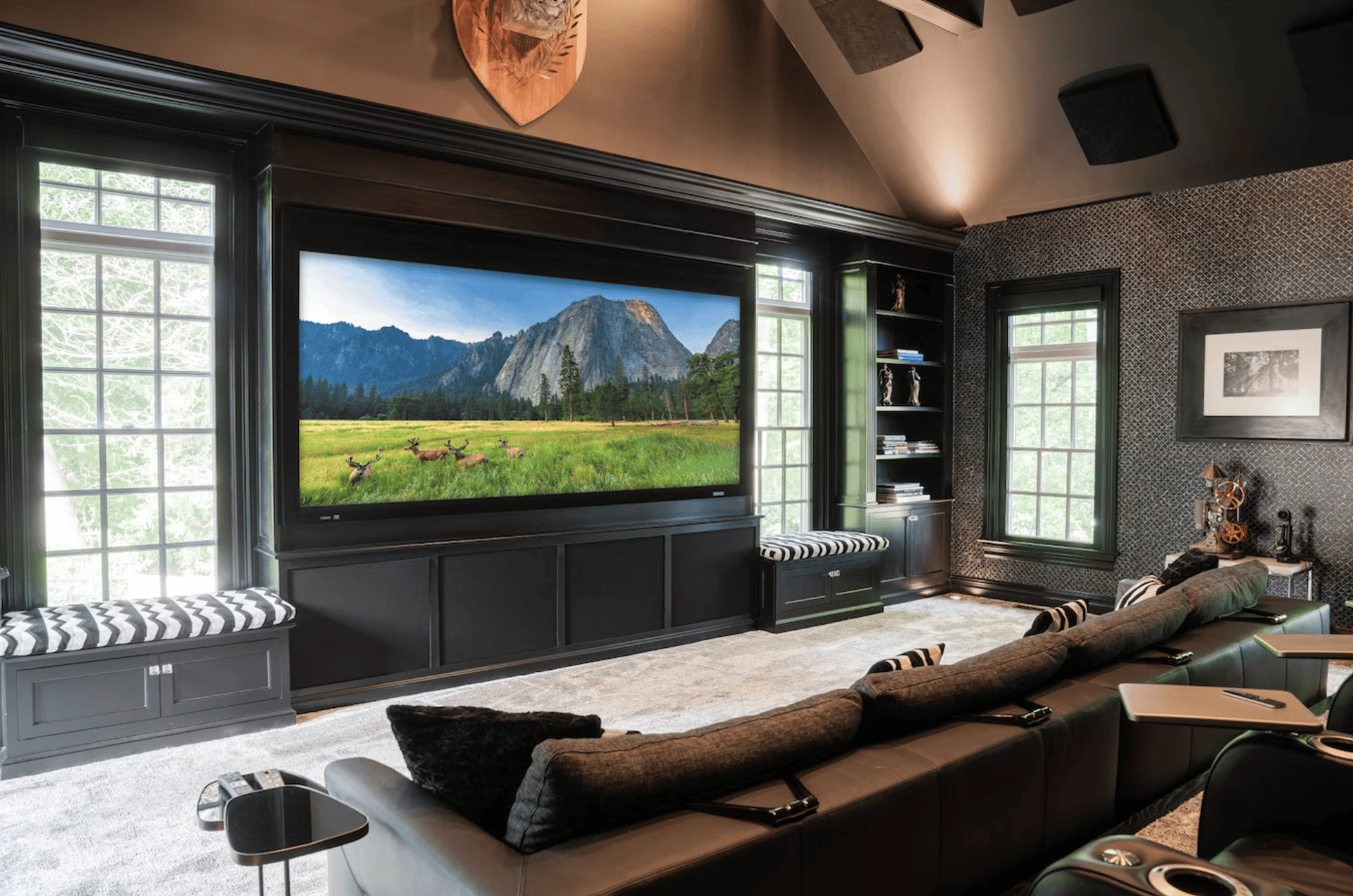
Once relegated to the basement, media and theater rooms are seeing the daylight. (Gramophone/World Wide Stereo)
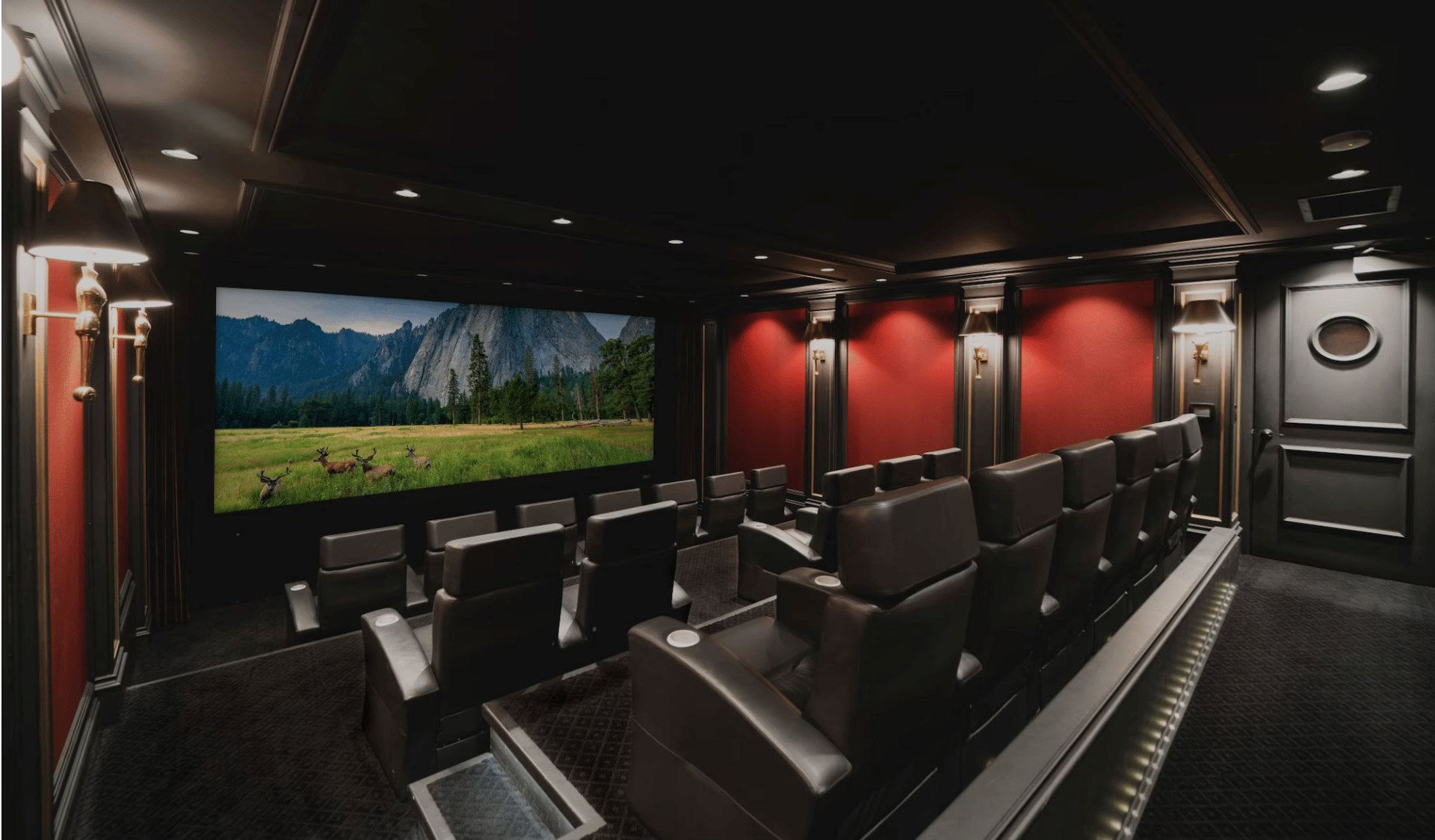
When Davis started his career in home remodeling almost 25 years ago, theater and media rooms were dedicated spaces often closed off from the rest of the house. A media room might offer greater flexibility in use and a surround-sound audio system with a flat-screen TV, but a theater space was hard-core, with 100-inch-plus projector screens and stadium-style seating on risers — even if they were more like cozy armchairs.
Differences aside, the spaces were similarly “hidden in a basement ... that had no natural light in it,” said Davis, whose firm is based in Hunt Valley, Maryland. “They’ve really evolved into more of an open space design. So, more family and entertainment friendly.”
So, if an entertainment space is in the basement, Davis said, Gramophone is seeing a preference for open-plan rooms with vibrant accent lighting and atypical materials, such as industrial-style metal beams.
Jordan McDonough, founder of Los Angeles design-as-investment studio Somerled Designs, is seeing clients crave cozier spaces focused on “comfort and seating capacity,” he told Homes.com News via email.
“Trends we’re seeing include oversized sectionals, flexible seating layouts, and thoughtful circulation so the room can accommodate groups without feeling cramped.”
It’s an environment that supports the kind of space Somerled suggests for Super Bowl and Olympics viewing, one with “a highly comfortable, conversational game-watching setup rather than stadium seating, since it allows people to interact more naturally throughout the event,” McDonough added.
Prime-time sporting events aside, Gramophone is also seeing clients opt for casual comfort in the spaces, perhaps because they use them more for streaming purposes than broadcast TV.
Streaming is often “very impromptu and on the fly,” Davis said, making entertainment easier to engage in, leading clients to crave more comfortable, casual viewing spaces.
“We’re seeing more couches and love seats,” Davis said. “It’s a higher comfort and higher entertaining-level factor that I feel our region is demanding.”
But part of that comfort is made possible by technological advances. Instead of traditional bulb-powered projector screens, clients can specify flat-panel displays that often exceed 115 inches.
“That means you don’t have to have the lights off,” Davis said. “So, the spaces are more welcoming, less dungeon-like.”
Davis is also seeing some residential clients embrace the customized microvideo walls once reserved for high-paying commercial clients. Comprising 6-by-6-inch LED square panels that connect seamlessly to create a single giant screen, these screens allow for ample natural light with no glare, he explained.
But a picture is only half the equation in an entertainment space, and speakers have a reputation for being hulking and noticeable. While some speakers look like a “gorgeous musical instrument,” Davis said, general advances in speaker technology mean designers can embed sound systems in the drywall, so a client won’t even see a speaker cutout in the wall, let alone the speaker itself.
Just hiding those “giant black box” speakers can have a “high spousal approval factor,” he said.
So, what does it cost to build the entertainment space of your dreams?
For a DIY theater room, Davis estimates the cost would be $10,000 to $20,000 for reputable projector screens, sound systems, cabling and other parts.
Custom projects can get into the six-figure range, Davis said, and ultra-luxury projects often go well over six figures. But those are often very specific, with clients requesting themed rooms that replicate vintage cinemas or Egyptian pyramids.
“We’ve done hidden theaters with bespoke doors so that people don’t know the room exists,” he recalled. “They’re looking for something special, unique and something that’s cool to show off to friends and family when they come over."
Aesthetics aside, the latest technology doesn’t always come cheap. Those microvideo screens Davis mentioned earlier? They can clock in above $100,000, but that’s far below the $500,000 to $1 million-plus range they once occupied.
Now, it is on par with the laser-based projectors Gramophone and World Wide Stereo currently install, which can be in the $50,000 to $100,000 range.
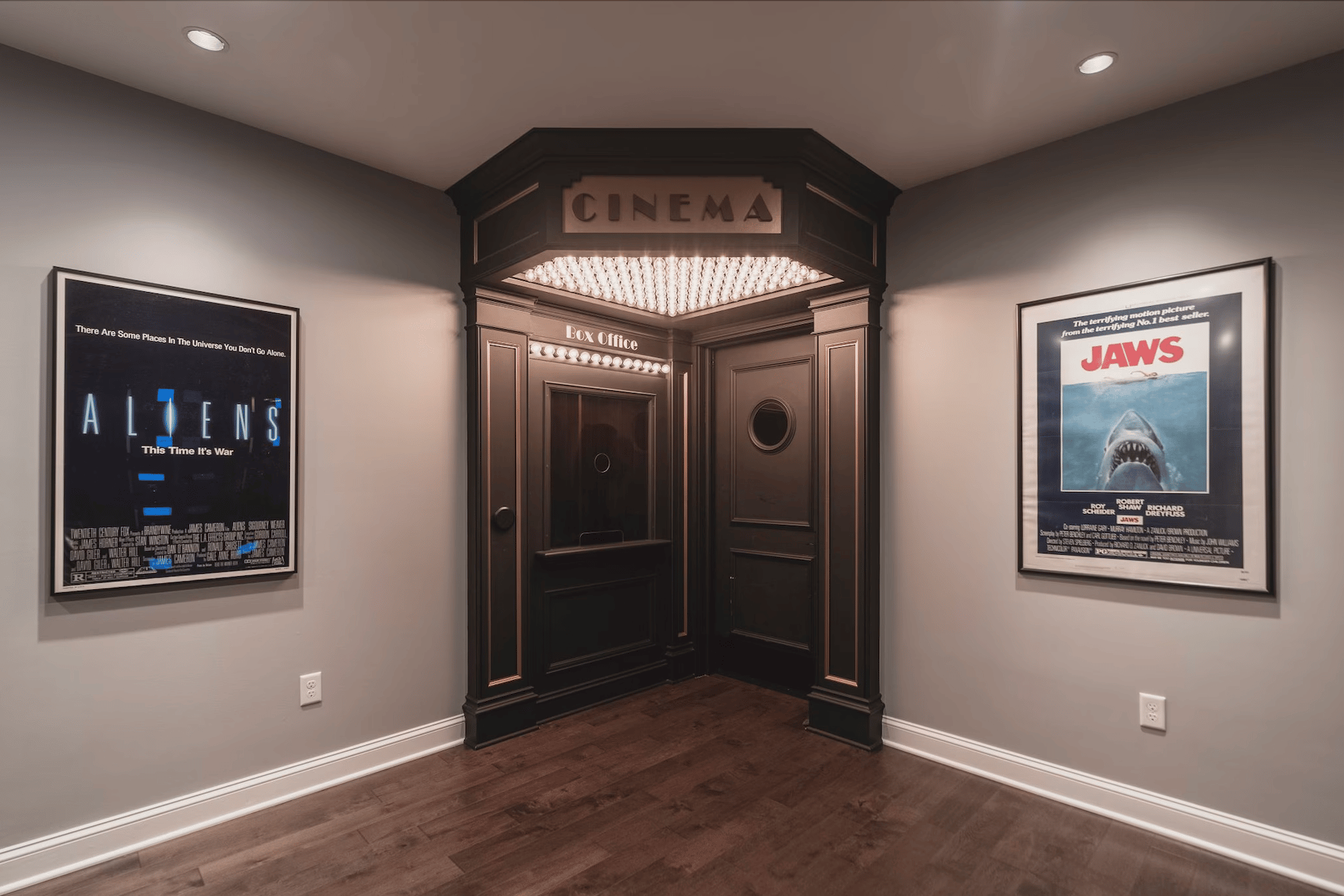
This custom space even has an imitation box office. (Gramophone/World Wide Stereo)
These spaces can add a certain value to a home, McDonough and Davis suggested. Sometimes, it’s quantifiable financial value: Somerled helps its clients design home spaces that they can rent out, turning a well-designed accessory dwelling unit project into an investment opportunity.
Media rooms are a “strong [return on investment] driver when designed intentionally,” McDonough said. “We see the biggest payoff when these spaces are created where people naturally gather — especially in homes and short-term rentals designed for families, groups of friends and game-day hosting.”
That return can be more noticeable in markets with “a strong ‘team presence,’ where guests are traveling specifically to watch games together,” he added. “In those cases, media spaces become a core amenity rather than a nice-to-have.”
In many other cases, the spaces offer a value that’s trickier to pin down.
“These spaces don’t only serve as venues for streaming something or watching TV,” Davis said. “They can be for collaboration.”
The designer pointed to his theater, for example. Although basement-bound, it’s wide open to encourage easy flow and big groups. His daughter’s sports team recently curled up on the couches to watch game film. Davis has another customer who outfitted the space with microphones so their young children could perform and sing.
“These spaces are much more than just watching the Super Bowl,” Davis said. “And I think the evolution of that is continuing to drive demand.”
Original article by: Madeleine D'Angelo, Homes.com