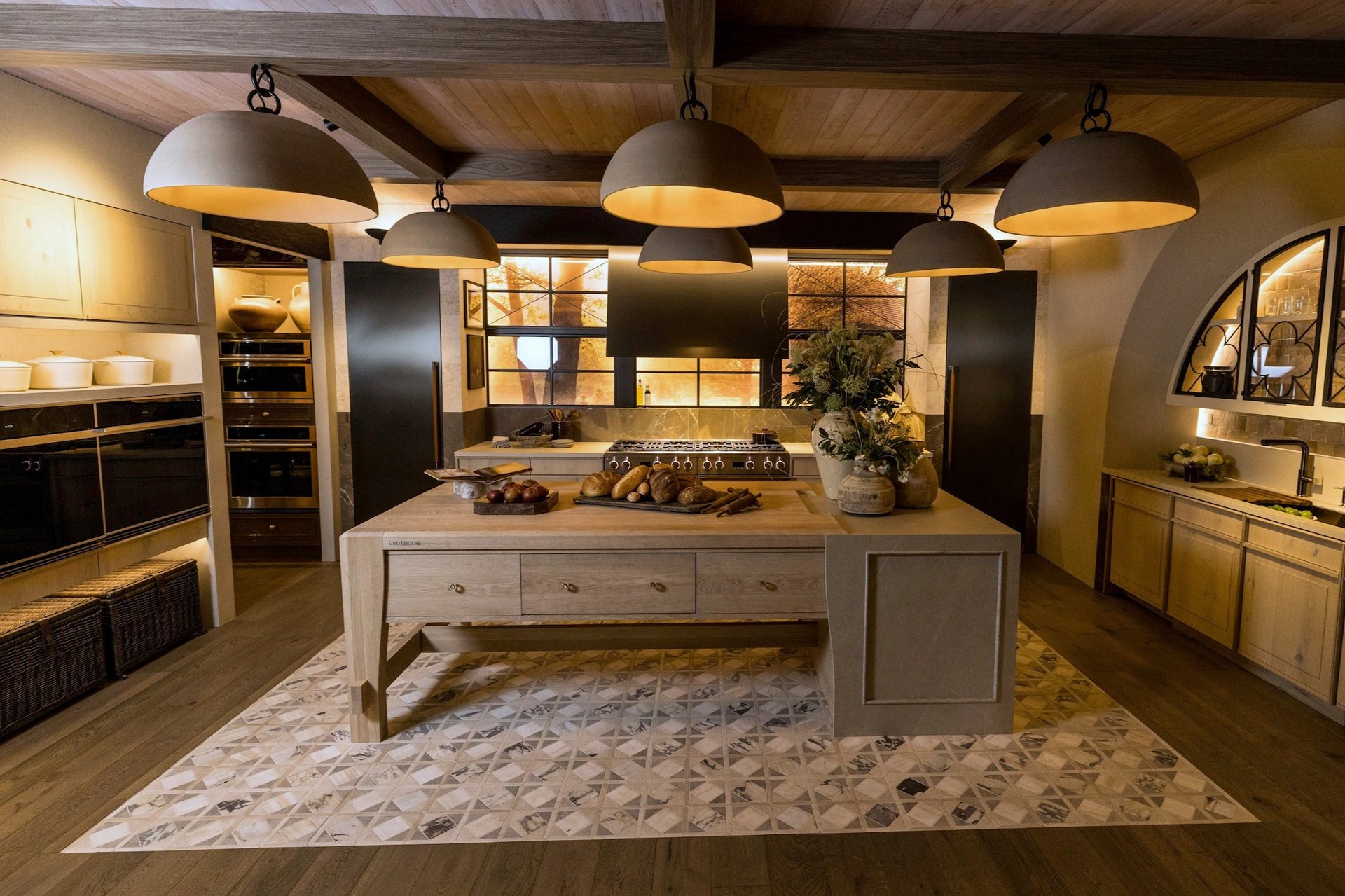
Monogram's Iconic Kitchen at Design and Construction Week showcased a growing trend of blending living room comfort and furniture design into the kitchen. (Monogram)
Black leather ropes formed a squiggled line of interior designers waiting their turn to enter a dark, makeshift room that exuded an air of exclusivity. The loud music from the dim interior wasn’t coming from a nightclub, but rather, a model kitchen for luxury appliance brand Monogram set up this month at the design and building industry’s largest trade show. The space, resembling more a lounge or even a living room than a functional kitchen, is being envisioned as what’s in. Professionals at Design and Construction Week in Orlando said there’s a living room-ification happening to kitchens, and even bathrooms, as consumer behavior moves toward seeking comfortable spaces.
Inside the Monogram display, a stone fireplace from Artistic Tile was located next to a retro burlwood-paneled armoire from Bentwood that’s actually a hidden refrigerator and bottom freezer. Refrigeration drawers hid behind stone cladding on a nearby wall. A tile inlay resembled an area rug. What appeared to be a long wooden dining table sitting in the middle of the room, with built-in appliances and dresser-like drawers, was actually the kitchen island.
Monogram, a sister brand to GE, called the space its “Iconic Kitchen” — a “benchmark for modern luxury” from creative director and principal at Raith Design Richard T. Anuszkiewicz.
“You’ll notice that the kitchen today is much more than that once utilitarian space, it’s certainly the living room,” Anuszkiewicz said in a video tour of the Monogram space with popular YouTube channel Homeworthy, pointing to a plush seating bench.
Designers and other brands at the trade show agreed.
"It's not just in our kitchens, if you think about when you go into retail spaces, almost everywhere, we want to feel like we're in a cozy, relaxed living room environment. ... In the kitchen, it has to be so intentional because everything has a hard surface," TK Wismer, designer and creative director at appliance brand GE Cafe, told Homes.com News.
Lounging in more than one place
For more than a decade, open-concept floor plans preferred by homeowners have forced designers to take inventory of how kitchens intertwine with adjacent living rooms. But today, the kitchen is coalescing with the living room more than ever as consumer behaviors shift.
“We’re not using our living rooms the way we used to,” designer Arianne Bellizaire of Arianne Bellizaire Interiors told Homes.com News. “We used to rally around a fireplace and a television because that is the way we shared and were communal in that space. Now everybody’s on their screen.”
When Bellizaire sits on the couch with her daughter, she might be watching TV or on her phone while her daughter uses an iPad. “That experience doesn’t just happen on the sofa anymore. It now happens at the bar, the kitchen island, on a bar stool,” said Bellizaire.
Designers say the kitchen took on more functions during the pandemic than ever before, with the central island becoming a workspace or a spot to get homework done. Six years later, that evolution is moving kitchens further along, ushering them into an era in which homeowners demand familiar comfort across multiple rooms.
At the Monogram booth, Anuszkiewicz described the aesthetic as “quiet luxury,” characterized by neutral palettes and luxe, subtle features such as custom-paneled appliances that hide within the walls. While concealing a refrigerator is nothing new, the lengths designers are going to make fixtures look like proper furniture items are taking a new form.
Major manufacturers across the Design & Construction Week show floor showed off minimalist appliances that visually disappear. Luxury brand JennAir, for example, debuted leather doors for its refrigeration columns last year, and LG Electronics launched its Seamless Collection.
Appliances take shape of furniture
The concept of quiet luxury is moving toward richer, unique materials — picture items that might feel more appropriate for a living room, such as a refrigerator that looks like an armoire.
“We’re looking at it in a cohesive way where we’re thinking, ‘If this is how you live in your living room, we don’t want to go into the kitchen and feel like it’s a completely different personality,’” said designer Hill Rondero of Ro House Studio. “And so, the kitchen, because we spend so much time in it, it needs to act like a living space.”
Architect Bob Zuber, a principal at Morgante Wilson Architects, previously told Homes.com News that his luxury clients request what he calls “Starbucks rooms” in kitchens, which include a fireplace and plush seating that add a layer of ambiance.
Kitchen islands are looking more like dining tables and with the trend of double kitchen islands, designers are taking more creative liberties as these must-haves become permanent. Islands are now likely to take on round forms or use furniture-like legs — a phenomenon also seen in bathrooms, where vanities closely resemble furniture repurposed with a sink.
And what would the living room-ification of the kitchen be without novel charging options for electronic devices?
FreePower partnered last year with Cosentino, offering hidden charging spots beneath kitchen countertops that light up and power up smart electronics placed on the unseen pad. And cabinetry brand Fabuwood now offers its InFocus Drawer with FreePower, an in-drawer charger that works the same way.
Coffee table appeal for the kitchen
Rondero highlighted other ways in which living rooms and kitchens are blending.
For one, she's adding more layers of lighting to the kitchen, ensuring the cooking area has warm, soft light typical of a cozy living room rather than harsh recessed lighting.
Online, there’s been trends like 2024’s “fridgescaping” where people curate the interiors of their fridges, adding flowers or artwork to up the aesthetics of their grocery storage. Though the trend never truly took over the interior design community, designers are infusing more artwork into kitchens that strikes a balance between living room decor and kitchen sensibilities.
Rondero suggested kitchen art pieces be placed in an open or glass-front cabinet. A sculptural decor item could be used to hold dishware.
It comes down to “bringing in things that are more textural and interesting that you would have on a coffee table and bringing them into the kitchen,” Rondero said.
Designers and brands are also trying to convey a more relaxing atmosphere through warmer hues and less white, more curves rather than sharp edges that carry throughout the house.
“At times, it almost seems like there’s no transition from the living room; it is just tied together,” said designer and real estate agent Laurie Coton of Coton House.
Original Article by: Caroline Broderick