Gary Dolch
Phone
512-656-5627
Email
[email protected]



With the full set of nationwide metro data now available, Austin ranks as the #1 best-performing Top 50 U.S. metro for job growth in 2025.
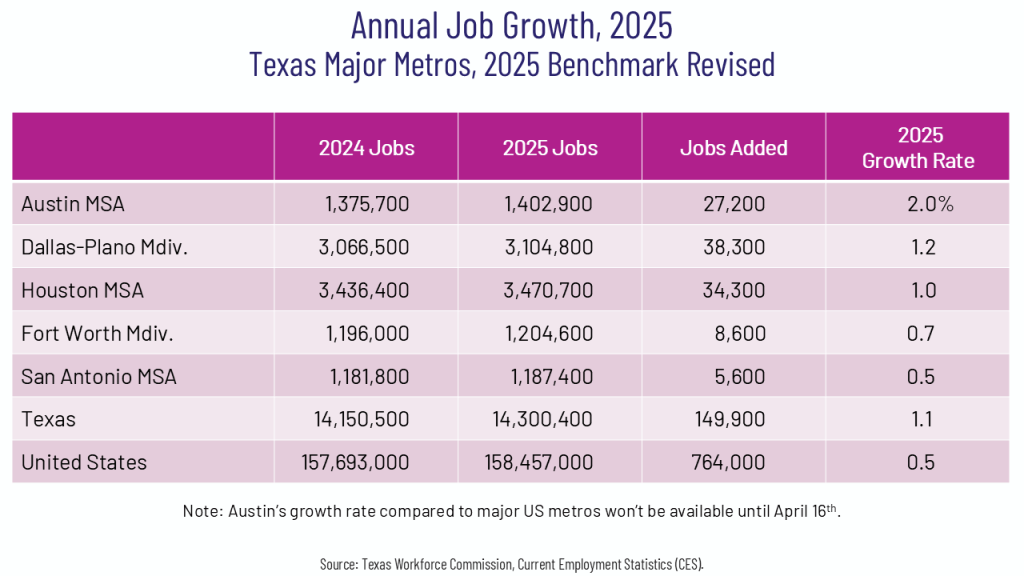
The Austin region ranked as the best-performing among the 50 largest U.S. metros for job growth in 2025. With 27,200 jobs added, Austin posted a 2.0% growth rate—0.5 percentage points higher than the next-fastest metro. Rounding out the top five were Columbus MSA (1.5%), Salt Lake City MSA (1.3%), Miami MDiv. (1.3%), and Dallas MDiv. (1.2%).
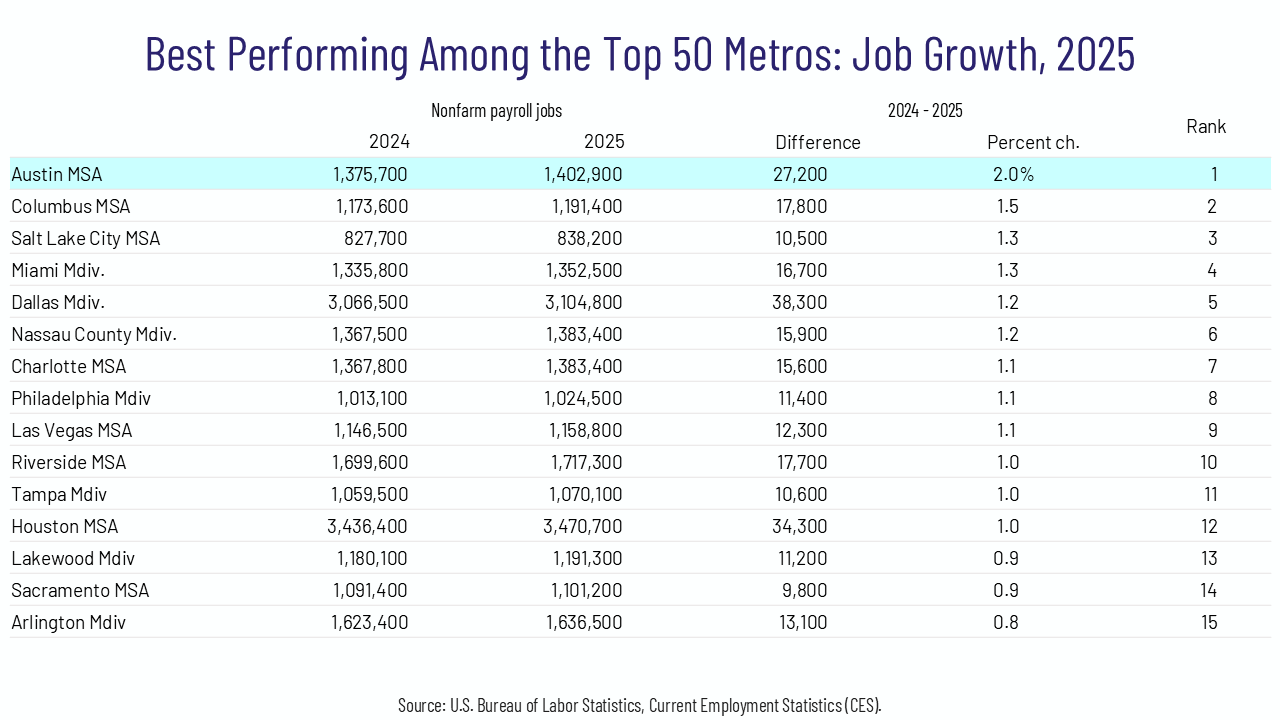
Texas job growth totaled 1.1%; however, aside from Austin and Dallas, no other Texas market placed in the top 10. Houston MSA ranked 12th with 1.0% growth, while Fort Worth MDiv. (0.7%) and San Antonio MSA (0.5%) ranked 17th and 25th, respectively.
Nationally, job growth reached 0.5%, while metropolitan areas averaged slightly lower at 0.4%. Washington, D.C. ranked last, with employment declining by 1.8%, and was one of 16 metros to record negative job growth.
Chris Ramser, Vice President & Joseph Morones, Director of Research
Job growth in 2025 for the Austin region exceeded earlier projections, based on annual benchmark revisions from the U.S. Bureau of Labor Statistics (BLS) released in early April. Before the revisions, the number of nonfarm payroll jobs in the Austin region was 1,389,400 jobs in December 2025, while the revised data now places that total at 1,420,100. The graph below shows the new numbers plotted against the preliminary release (dotted black line) that was published in February.
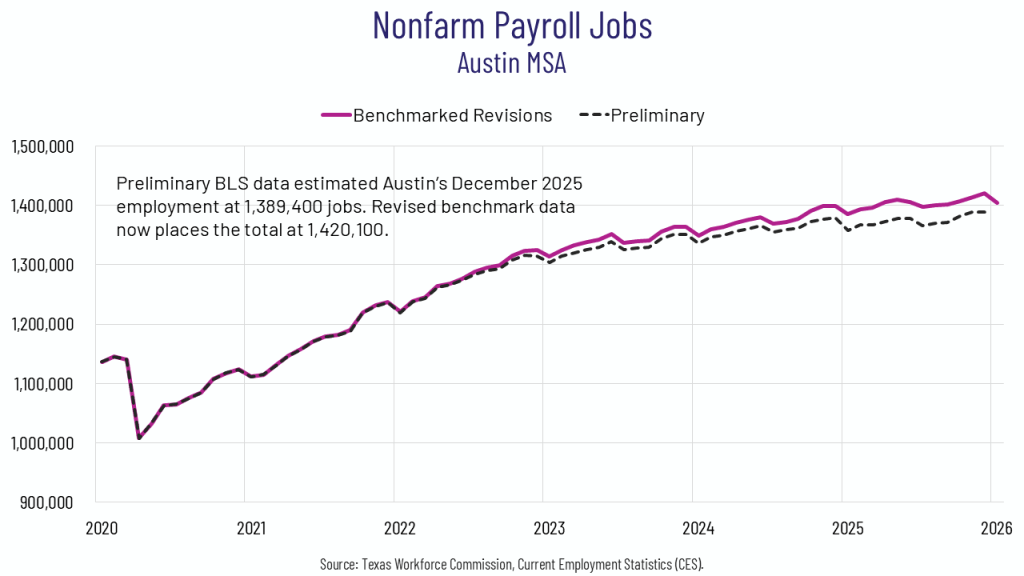
With the revisions, Austin’s 2025 job growth reached 2.0% (27,200 jobs), significantly higher than preliminary estimates. Pre-benchmark data had shown growth of just 1.0% (14,133 jobs), trailing Texas (1.3%) and roughly matching the U.S. (0.9%). Following the update, Austin’s growth now stands at nearly twice the state’s pace (1.1%) and four times the national rate (0.5%). The below animated gif shows the annual number of jobs and growth rates for both the preliminary and final release.

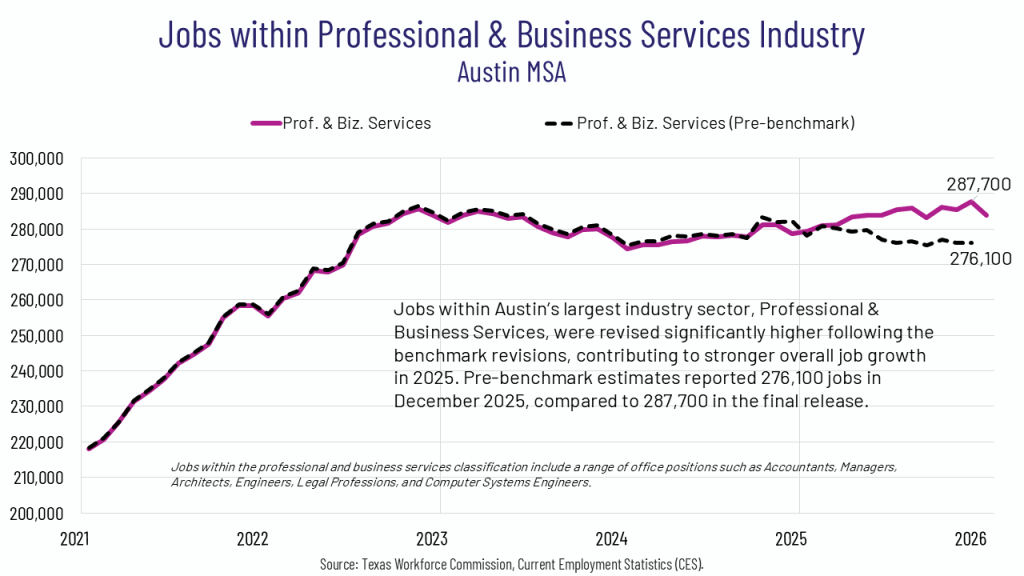
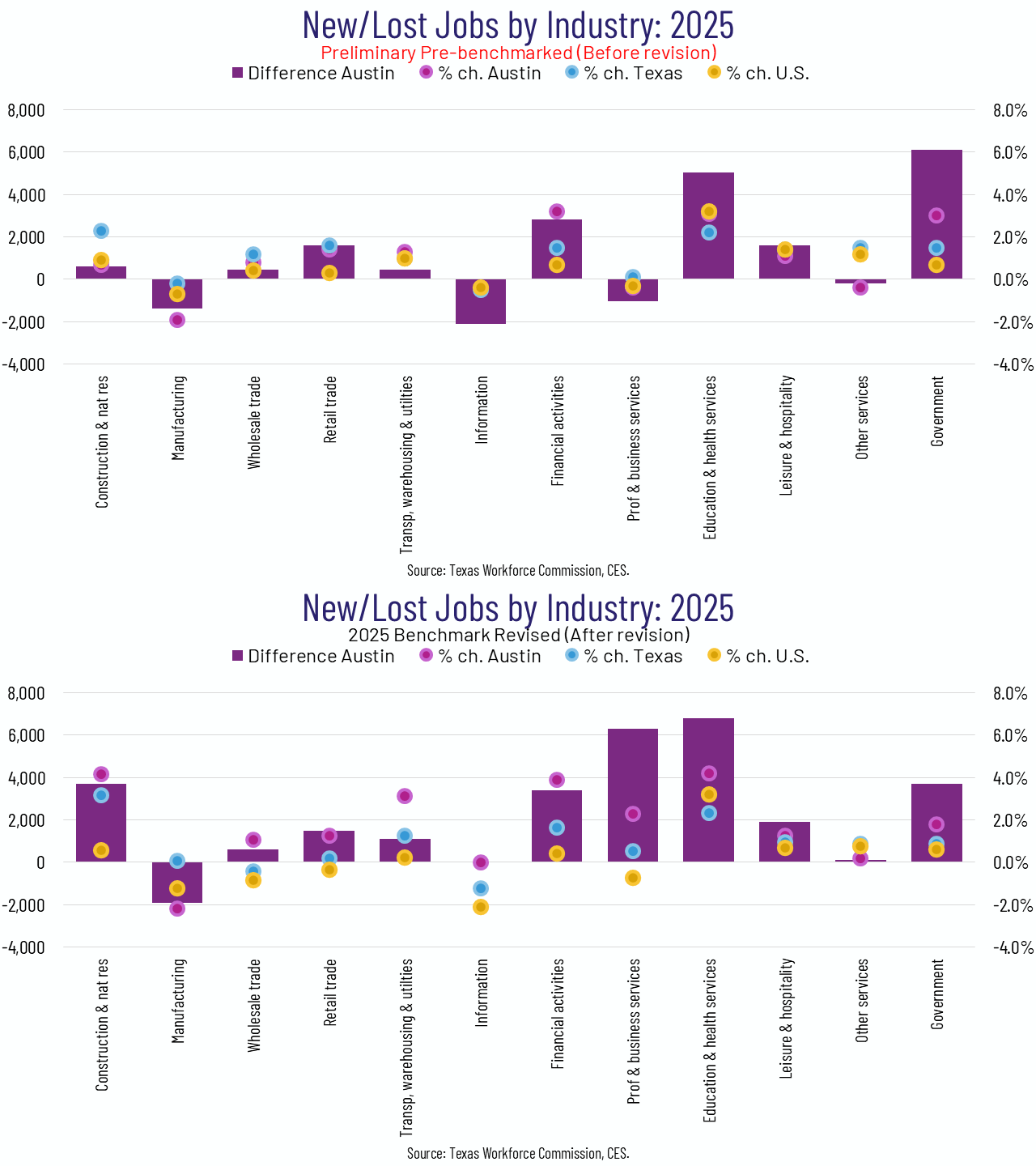
One industry that was impacted most by the revisions was Austin’s largest super sector, Professional & Business Services.[1] Professional & Business Services represents 20% of the payroll jobs in Austin with December 2025 employment originally estimated at only 276,100. With the revisions, this sector was now shown as having 287,700 jobs in December 2025. Growth in the sector was now 2.3% in 2025, which is a vast improvement over the -0.4% change that was originally estimated.
Several sectors in Austin showed notable differences in payroll employment following the revisions. Construction & Natural Resources saw significant upward adjustments, with 2025 growth revised to 4.2% from an initial estimate of 0.7%. Education & Health Services was also revised higher, increasing to 4.2% from 3.1%.
The animated graphic below compares preliminary and revised growth rates across major supersectors. Bars represent the number of jobs gained or lost in Austin during 2025, while dots show how Austin’s percent change compares to Texas and the U.S.
While the 2025 benchmark data is available on the Texas Workforce Commission’s website, the data has not yet been published for the entire US on the BLS site. Therefore, Austin’s job growth ranking amongst large US metros is not yet available. However, Austin outpaced all major Texas metros in 2025 for job growth. The Dallas–Plano Metropolitan Division grew by 1.2%, Fort Worth by 0.7%, Houston by 1.0%, and San Antonio by 0.5%. The below table summarizes 2025 job growth for these geographic areas.
Austin’s seasonally adjusted unemployment rate of 3.7% remains lower than other major Texas metros. Fort Worth recorded 4.0%, Dallas 4.1%, San Antonio 4.2%, and Houston 4.6%. Both Texas and the U.S. reported seasonally adjusted rates of 4.3%.

Austin’s not seasonally adjusted unemployment rate was 3.7% in January 2026, up from 3.5% a year earlier. This increase corresponds to 3,350 more unemployed individuals, bringing the total unemployed to 57,554.
After adjusting the monthly Non-farm payroll jobs data to the larger BLS Quarterly Census of Employment & Wages (QCEW) survey, Austin’s job growth rate for 2025 increased twofold from around 14,000 jobs to over 27,000 jobs. “White Collar jobs” in the Professional & Business Services sector which were originally reported as declining in Austin, saw a substantial adjustment and grew by 2.3% in Austin during 2025. This revision should propel Austin into the Top 10 for Fastest Job growth among major U.S. metros for 2025 when the national data is released on April 16th. OA will share Austin’s ranking when it becomes available.
Austin’s housing market could be poised for renewed momentum as the metro continues to outperform nearly every major U.S. city in job creation. Revised labor data now shows Austin added more than 27,000 jobs in 2025 — nearly double earlier estimates — making it the fastest-growing large metro in the country for employment growth. Strong hiring, particularly in Professional & Business Services, signals that the white-collar workforce many feared was slowing has actually rebounded in a meaningful way. Combined with Austin’s relatively low unemployment rate of 3.7%, these trends suggest continued population inflows, household formation, and housing demand moving further into 2026.
For the housing market, this likely means stabilization first, followed by selective appreciation in high-demand neighborhoods and suburban growth corridors. While Austin has experienced a cooling period after the pandemic-era surge, sustained job growth historically acts as one of the strongest long-term drivers of home values and buyer confidence. More residents relocating for work creates demand not only for home purchases, but also for rentals, new construction, and luxury housing. If mortgage rates begin easing later this year, Austin could be positioned for a stronger-than-expected rebound compared to many other major metros that are seeing slower economic growth or even declining employment.
[1] Examples of jobs within the Professional and Business Services classification include a range of office and management positions including accountants, managers, architects, engineers, legal professions, and computer programmers & engineers.
Original Article by Opportunity Austin